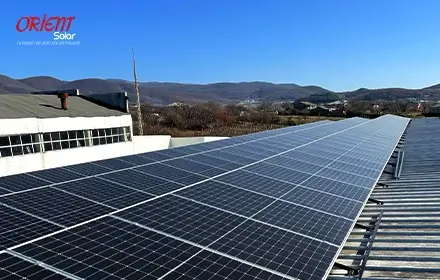
As our nation continues its race to achieve 500 GW of renewable energy capacity by 2030, solar rooftop systems have become a game-changing solution for micro, small, and medium enterprises (MSMEs), corporations, and institutions. With initiatives like the PM Surya Ghar Yojana to drive adoption in 2025, if you pursue a solar project utilizing solar panels, you can save on costs and provide a more sustainable solution and source of energy independence.
This guide provides the necessary details on how solar projects help these sectors, assesses the best current photovoltaic (PV) technologies—mono PERC, NN-type TOPCon (mono and bifacial solar panels), HJT solar PV modules, and IBC—and presents solar technologies that will be the way of the future.
India's energy landscape is changing rapidly by 2025, with solar projects benefiting businesses and institutions in ways never imagined before. Herein, we are going to illustrate how solar rooftop systems are empowering MSM corporations and institutions by serving their needs and offering real value.
The cost of electricity is a huge cost for Indian businesses. In 2025, commercial tariff rates for electricity are still between₹8 and ₹12 per unit. Solar panels enable corporations and institutions to generate electricity, and those savings translate into significant savings in the cost of operations. A solar rooftop of 5 kW can cost an MSME owner ₹50,000-₹80,000 less per year. A 100 kW solar deal could save their business upwards of ₹1 lakh each year.
Institutions like hospitals and universities will only benefit from having solar panels installed. After installation, hospitals may cut their energy costs by 70% or more. The PM Surya Ghar Yojana provides subsidies up to 40% on the total installation cost (for 1-3 kW systems—30,000-78,000). Thus, solar rooftop systems for homes are within close range of the cost of commercial set-ups (60,000-180,000 for 3-5 kW systems).
India's electricity grid suffers from outages and fluctuating voltage, and this interrupts MSME (like manufacturing plants) operations and institutions (such as hospitals, which need a constant power supply). Rooftop solar systems combined with modern inverters and battery storage enable unlimited energy supply, limit interruptions to power supply, limit downtime, and protect income streams.
Bifacial solar panels produce power from both sides and create an additional 5-30% energy production, so even on a cloudy day or in monsoon season, companies can utilize the additional solar energy production for operations. Corporations that use solar for projects that are large-scale projects can implement a solar hybrid system to store energy surplus, with a reduction of downtime, whereby institutions can VALUE the stability of having consistent power for critical activities to withstand the resilience of the dynamic 2025 energy transformation.
In 2025, PM Surya Ghar Yojana has exceeded and targeted 10 million households, even with the larger commercial solar projects. The national government considers these as MSMEs, as when they profit, our young generation has work. There are substantial subsidies for MSMEs under the PM Surya Ghar Yojana and interest-free EMI loans for either 3 or 6 months, with an online loan approval process approved within 48 hours.
Corporations are able to use accelerated depreciation (up to 40%) and viability gap funding under the Solar Park Scheme, lowering the total equilibrium of solar panels within the existing market. Institutions are able to gain grants, exemptions, and benefits from all institutions related to the national agenda, such as PM Surya Ghar Yojana, covering all installation costs, such as up to 60% of installation costs for educational institutions and healthcare facilities.
These incentives enable access to solar technology, bringing the solar panel for business price to ₹29-32/watt for commercial-grade solar panels.
Corporations and institutions prioritize Environmental, Social, and Governance (ESG) compliance today, and in 2025, the focus will become intense. The undeniable reality is that solar projects reduce carbon emissions—solar power replaces power previously provided by coal, in line with India's aim to reduce its emission intensity by 45% from 2005 levels by 2030.
The MSMEs adopting solar rooftop systems can market their sustainability initiatives to environmentally aware customers and clientele. Corporations that facilitated the installation of bifacial solar panels or TOPCon solar panels showcase a new stage of green leadership and innovation, and are abounding in enhanced brand reputation.
Institutions such as universities earn goodwill from their community by exhibiting conscientious and responsible behaviors in an environmental sense, which makes solar technology a strong asset in terms of future stakeholder engagement.
Properties with solar panels will have higher market value in 2025 than those without solar, particularly since sustainable energy sources will become a large criterion for buyers looking for energy-efficient properties. MSMEs benefit most from solar rooftop systems to invest in costs for infrastructure and equipment and as a result, resell properties at an increase of 3 to 4% for commercial properties. Corporations that undertake and invest in large-scale solar projects will achieve a return on investment in between four and five years' time and invest in solar infrastructure to gain access to decades of essentially free electricity, as solar panels have typical lifetimes of around 25-30 years.
Institutions exemplified as schools will be able to benefit from savings on operational budgets, which they are able to spend on their work, as opposed to utilities. Bifacial and HJT solar PV modules render a higher yield to enable investors to shorten their ROI and enjoy the greatest long-term savings.
Solar is one of the most adaptable types of technology, therefore capable of fulfilling a wide range of energy requirements. MSME companies can start with a solar rooftop system as small as 3-10 kW, and corporations are deploying MW-scale solar projects on large factories or office buildings. Institutions will string together solar panels, whether on rooftops, carports for EV charging, or agrivoltaic systems that become increasingly relevant in 2025 for applications like water heating.
TOPCon solar panels and HJT solar PV modules are ideal for small footprints with high efficiency, while bifacial solar panels are suitable for applications in reflective situations to have flexibility for a wide range of installation requirements in 2025.
Solar projects create job opportunities for manufacturing, installation, and maintenance work. Medium and small enterprises (MSMEs) are getting access to local jobs while corporations provide renewable energy capacity to India's renewable energy system.
Institutions, especially those located in rural areas, are using solar technology to enhance local conditions to develop community-based economies, working in accordance with the PM Surya Ghar Yojana with regard to people's inclusive growth. The solar sector is expected to generate over 1 million jobs25 with respect to enhancing local economies and enabling communities to become businesses.
Selecting the best solar technology is vital in terms of maximizing energy output and ROI. In this review, we carry out a comparative analysis of 550W Mono PERC, 600Wp N-Type TOPCon (mono and bifacial solar panels), HJT Solar PV Modules, and IBC. We determine the application for each solar technology for different sectors.
Mono (Passivated Emitter and Rear Cell) solar panels are manufactured using monocrystalline silicon with a rear passivation layer, and efficiencies are 20-22%. Mono PERC panels are cost-competitive and commonly used in India’s solar portfolio.
Suitability:
MSMEs: Very suitable for small solar rooftop systems and very economical (₹29-30/watt), also performing well under direct sunlight as they have proven reliability. Thus, great for limited budgets or available roof area.
Corporates: Applicable to mid-cap solar projects that provide savings, for example, in a commercial warehouse or office building.
Institutions: Works well for schools or small hospitals with standard rooftops and is reasonably equivalent to standard solar panels in price (₹60,000-₹150,000 for 3-5 kW).
Pros: They are cost-competitive, reliable when tested, and generally perform well under low light. Mono PERC solar panels are widely available from manufacturers such as ADM Orient Solar.
N-type TOPCon (tunnel oxide passivated contact) solar panels have efficiencies of 22-24% utilizing advanced rear-side passivation. The 600Wp versions (in both mono- and bifacial solar panels) deliver up to 780Wp with bifacial gain for high-energy needs.
Suitability:
MSMEs: The n-type TOPCon solar panels with a bifacial configuration will suit businesses where the rooftop has reflective materials (for example, white TPO roofing), which maximizes energy yield. Though the price of solar panels is higher (₹30-32/watt), the added amount of output provides a justified return on investment of electricity generated.
Corporates: Suitable for larger-scale solar projects, including industrial plants, solar farms, etc., due to heightened efficiencies and minimal degradation rates of 0.4-0.5% annually.
Institutions: Suitable for campus-like buildings with reflective surfaces (for example, gravel or snow), where adding bifacial solar panels is an expected increase in post-deployment output of ~30%.
Advantages: High efficiency, low temperature coefficient for hot climate conditions, and high bifaciality for TOPCon solar panels. Lastly, they last 30 years, ideal for a country such as India, with its varied conditions.
In 2025, the leading emerging solar technologies are HJT solar PV modules and IBC; both will raise efficiency and performance in the solar market in India.
Overview: Heterojunction (HJT Solar PV Modules) is a hybrid PV technology combining crystalline silicon with thin-film layers, producing efficiencies of up to 24%, reliability (up to 92%) along with low-light conditions, and premium-positioned solar technology.
Suitability:
MSMEs: HJT Solar PV Modules will work for energy-intensive firms that have an adequate budget for solar technology (₹35-40/watt), and there is an expected even superior ROI, especially in reflective environments (e.g., pre-coated, glass-faced, CD, or other surfaces can provide reflectance).
Corporates: For large utility-scale solar developers or corporates who manage a commercial rooftop and are aligned to maximize efficiencies and ESG compliance.
Institutions: For high-profile campuses oriented towards sustainability, aesthetics, and prestige, needs will favor HJT solar PV module design over time.
Advantages: Highest efficiency, high bifaciality, and low degradation (0.25-0.5% per year). They excel in monsoons and diffused light conditions.
Limitations: High cost and sensitivity to humidity require careful installation.
Summary: IBC solar panels have all of their electrical contacts on the rear surface, providing no shading on the front and producing efficiencies of over 23%. They are a premium option with uniform aesthetics that work well in higher-value solar installations.
Applications:
MSMEs: Less common due to a cost between ₹40 and 45/watt, an IBC solar installation would work well for an MSME that places importance on aesthetics and efficiency, such as a retail showroom.
Corporates: Perfect for a premium solar installation, such as corporate headquarters, where appearance and maximum yield are important.
Institutions: Ideal for a university or research institute, where the sleek design of an IBC solar panel is ideal as it aligns with pure branding goals, with extremely high efficiency.
Advantages: Superior efficiency, no front-side busbars, and enhanced durability. IBC panels are highly reliable for long-term solar projects.
Limitations: High cost and limited availability in India, less accessible for MSMEs.
Next-generation solar technologies and smart monitoring systems enabled with AI-based performance optimization will improve solar rooftop systems for all sectors by 2027. These technologies will have higher energy yield and lower maintenance, translating to significant benefits.
Perovskite Solar Cells: Perovskite Solar Cells have the potential for efficiencies of above 30% with lower manufacturing costs. Although already deployed commercially, significantly not widespread, by 2026-27, perovskite solar cells could electrify solar rooftop systems, particularly targeted to cost-sensitive MSMEs.
Tandem Solar Cells: Tandem solar cells, which combine perovskite with silicon (e.g., HJT Solar PV Modules) with an expectation of efficiencies above 28%, appear to be entering the Indian market shortly (2027) for corporations with professed urgent accelerated solar development cycles.
Zero Bus-bar (0BB) Technology: Making solar PV more sustainable, 0BB will substantially reduce cost and therefore improve efficiency associated with resistive losses in materials. Zero-busbar technology is gaining traction in commercial-scale utility projects, with an expectation of being mainstream by 2026.
Advanced Bifacial Designs: Advanced bifacial solar designs that assure greater rear-side passivation and bigger wafer formats like G12R, as well as increased wattage outputs, are nearing publication for large utility-scale solar projects to outputs above 800 W with an expectation for rollout by 2027.
Smart Monitoring Systems: Smart monitoring systems that leverage technology will undergo integrated commercial deployment for selected organizations as part of the solar rooftop systems by institutions, corporations, etc., for improved performance optimization and reduced maintenance costs (real-time sensing systems implemented from monitoring systems).
MSMEs: For cost-effective solar rooftop systems ideal for small budgets or roof areas, choose the 550W Mono PERC solar panels. For a reflective rooftop (high-albedo environments), choose the 600 Wpp N-Type TOPCon solar panels in bifacial configuration to max out the MW and potential within the PM Surya Ghar Yojana subsidies addressable.
Corporates: For large-scale solar project installations, invest in the higher-range Mono PERC or N-Type TOPCon solar panels, as these technologies are high-efficiency (17% to 29%) and concentrate solar energy on environmental, social, and governance (ESG) goals.
Institutions: In selecting bifacial solar panels (TOPCon or HJT), consider how reflective your surfaces (campuses) will be, or if you want to prioritize aesthetics by using IBC panels as a premium installation, leverage the PM Surya Ghar Yojana to save money if installed.
ADM Orient Solar is one of the most reliable and reputable players in India’s solar market and one of the leading manufacturers of solar panels in India, providing high-quality and BIS-certified solar panels and solar rooftop systems designed for MSMEs, corporations, and institutions. ADM Orient Solar has the largest variety of mono PERC solar PV modules, in addition to N-type TOPCon solar panels, soon to launch, which are designed specifically for the conditions of India.
With the best expert EPC services, comprehensive 30-year warranties, and the best guidance for PM Surya Ghar Yojana applications, ADM Orient Solar provides seamless projects and maximum savings and sustainability. Their accompanying monitoring app, powered by AI, maximizes system performance and cost by offering maintenance reminders to ensure reliability for the life of the system.
In 2025, investing in solar power is a smart move for MSMEs, corporations, and institutions across India. It not only helps save on costs but also promotes energy independence and supports ESG compliance. By installing solar rooftop systems, businesses can significantly reduce electricity bills, increase property value, and contribute to the PM Surya Ghar Yojana’s vision of sustainable growth. For those seeking the best in solar technology, Orient Solar offers a range of high-efficiency solutions—550W Mono PERC solar panels ideal for budget-conscious MSMEs, as well as 600Wp N-Type TOPCon solar panels and advanced HJT Solar PV Modules, perfect for larger enterprises and institutions. Choose ADM Orient Solar to power your projects and drive your organization toward a greener, smarter, and more profitable future.
Frequently Asked Question
Request A Quote