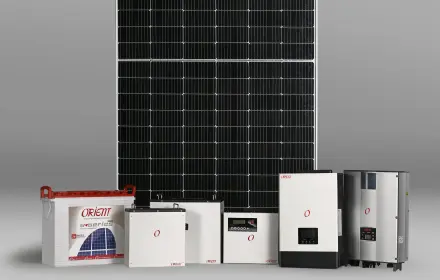
Looking to reduce your electricity bills and protect your home from frequent power cuts? Installing a solar system for your home in India is one of the smartest and most sustainable decisions you can make today. With solar technology becoming more efficient and government subsidies making it more affordable, homeowners across India are rapidly switching to solar power to gain energy independence and long-term savings.
Whether you live in a metro city or a remote village, a solar panel system can meet your daily energy needs while contributing to a cleaner, greener future. At Orient Solar, we provide high-quality and budget-friendly solar solutions that are designed to suit every Indian home—on-grid, off-grid, or hybrid. In this guide, we’ll walk you through the types of solar systems available, current prices, government subsidy benefits, and tips to choose the right system for your home.
The benefits of installing a solar system go beyond just cost savings. Solar power offers a reliable, renewable, and clean source of energy that can transform your home’s energy footprint.
Here’s why you should invest in a residential solar system:
Significantly reduce your monthly electricity bills—by up to 80%
Enjoy uninterrupted power supply during outages
Contribute to environmental sustainability and reduce carbon emissions
Increase your property value with a modern energy upgrade
Avail up to 40% government subsidy under MNRE guidelines
Benefit from low maintenance and 25+ year panel warranties
Access easy EMI and financing options for installation
Depending on your energy needs and budget, you can choose from three types of solar systems offered by Orient Solar:
An on-grid system is connected to the main electricity grid and is ideal for homes with a reliable power supply. It allows you to use solar power during the day and export surplus energy to the grid through net metering.
Lowest upfront cost since no battery is needed
Earn credits for excess electricity sent to the grid
Ideal for city homes with stable electricity
This system operates independently of the main grid and uses battery storage to supply power. It is best suited for remote or rural areas where electricity supply is inconsistent or unavailable.
Complete energy independence from the grid
Battery backup ensures continuous power during outages
Perfect for regions with frequent blackouts
A hybrid system combines both on-grid and off-grid features. It stores excess power in batteries and is also connected to the grid, giving you flexibility and reliability.
Ensures uninterrupted power supply
Allows switching between solar, battery, and grid power
Offers better energy control and backup
Choosing the right solar system depends on a few key factors, such as your energy consumption, rooftop area, and budget.
Check your last 12 months of electricity bills to find your average monthly usage in units (kWh). Divide the annual usage by 1,400 to estimate the required solar capacity in kW. For example, if your home uses 7,000 units a year, you’ll need a 5kW system.
Ensure your roof receives adequate sunlight and has around 100 sq. ft. of usable space per kilowatt. A 3kW system will require around 300 sq. ft. of shadow-free space.
Orient Solar offers advanced panel technologies to suit various needs:
Monocrystalline Panels – High efficiency, sleek appearance
Polycrystalline Panels – Affordable and reliable for budget users
Bifacial Panels – Generate energy from both sides of the panel
TOPCon Panels – Next-gen tech with industry-leading efficiency
If your area experiences regular outages, consider an off-grid or hybrid system with lithium-ion battery storage. These batteries are durable, maintenance-free, and designed for high performance.
The price of a solar system depends on its size, type, and components. Typically:
A 3kW on-grid system costs around ₹1.5 to ₹1.8 lakh
A 5kW system is priced between ₹2.5 to ₹3 lakh
A 10kW hybrid system may range from ₹4.5 to ₹5.5 lakh
Government subsidies can reduce the effective cost by up to 40%, making it a great value-for-money investment.
The Government of India offers generous subsidies under the MNRE Rooftop Solar Programme Phase-II to promote residential solar adoption:
Up to 40% subsidy for systems up to 10kW capacity
Net metering policies allow you to export extra power and earn bill credits
PM Surya Ghar Yojana offers extra benefits for eligible households
Orient Solar assists you at every step—from documentation to approval—to make subsidy claims simple and seamless.
Choose the right capacity based on actual energy use
Use BIS-approved components for quality assurance
Apply for available subsidy schemes to reduce upfront cost
Opt for routine maintenance to keep the system running at peak efficiency
Monitor energy generation through mobile apps provided by Orient Solar
Upgrade to hybrid later if your power needs increase
Orient Solar is one of the most trusted solar brands in India, delivering end-to-end residential solar solutions with superior performance and customer service.
Multiple panel options including Monocrystalline, Bifacial & TOPCon
Affordable pricing with easy financing and EMI options
Expert consultation, site survey, and flawless installation
Long-term warranty and performance guarantees
Full assistance for subsidy application and net metering
Buying a solar system for your home in India is no longer just an option—it’s a necessity for smart, sustainable living. With affordable solar prices, strong government support, and high-efficiency systems from Orient Solar, you can power your home more efficiently and reduce your dependency on the grid.
Ready to go solar? Visit Orient solar today and book a free site visit or consultation with our solar experts. Make the switch now, and enjoy clean energy for years to come.
Frequently Asked Question
Request A Quote