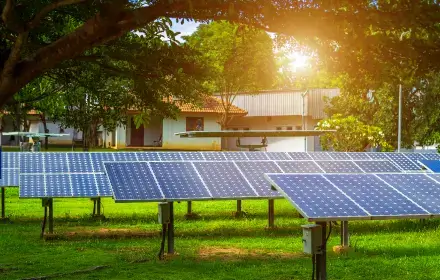
India is entering a transformative phase in its clean energy journey. A new study by The Energy and Resources Institute (TERI) reveals that the country’s total solar potential now stands at an estimated 10,830 gigawatts (GW). This is more than 14 times higher than the earlier 2014 estimate of 748 GW by the Ministry of New and Renewable Energy (MNRE).
At Orient Solar, a trusted solar panel manufacturer in India, we see this as a defining moment for the future of renewable energy. This report provides a clear direction for scaling solar across every corner of the country—from rooftops and farms to water bodies and infrastructure.
The TERI report, titled “Reassessment of Solar Potential in India: A Macro-level Study,” takes a fresh look at how solar can be deployed across varied environments. It covers traditional ground-mounted systems as well as innovative categories like floating solar, agrivoltaics, urban PV installations, and building-integrated photovoltaics (BIPV).
The report breaks down the total solar potential as follows:
Ground-mounted PV (on barren and unculturable land): 4,909 GW
Floating solar PV (on lakes, reservoirs, and other water bodies): 100 GW
Rooftop PV (urban and rural combined): 960 GW
Rural rooftops: 600 GW
Urban rooftops: 360 GW
Agrivoltaic systems (horticulture, tea, and coffee plantations): 4,177 GW
Urban and infrastructure-integrated PV (railways, roads, buildings): 684 GW
This comprehensive approach presents a more realistic and scalable roadmap for achieving India’s renewable energy targets.
India has committed to reducing its emissions intensity by 45 percent by 2030 and achieving 50 percent of its installed electricity capacity from non-fossil fuel sources. The country also aims to reach net-zero carbon emissions by 2070.
Electricity demand is projected to rise sharply, reaching over 9,300 terawatt-hours (TWh) by 2070. Harnessing solar energy at this new scale is essential for meeting future demand without increasing carbon emissions.
As a leading solar panel manufacturer and EPC solutions provider in India, Orient Solar is well-positioned to contribute to this vision. We offer advanced Topcon solar panels, bifacial modules, and high-efficiency hybrid inverter systems designed to perform across various use cases.
Our areas of expertise include:
Residential, commercial, and industrial rooftop solar installations
Floating solar power projects
Agrivoltaic system design and implementation
Utility-scale ground-mounted solar plants
Smart hybrid solar inverters with MPPT technology
End-to-end EPC and maintenance services
With our extensive experience and cutting-edge solar technology, we are committed to making solar energy more accessible, affordable, and effective across India.
Ajay Shankar, Distinguished Fellow at TERI, emphasized that solar energy is now the cheapest source of clean power in India. He urged a shift in conversation from feasibility to execution.
Dr. Vibha Dhawan, Director General of TERI, noted that agrivoltaics can help farmers increase their income while utilizing land more efficiently.
Dr. Mohammad Rihan, Director General of the National Institute of Solar Energy (NISE), stated that India’s power demand will double by 2060, and solar must become the dominant source in the grid. This makes proper assessment and preparation more important than ever.
Agrivoltaics: The report highlights over 4,000 GW of potential from horticultural land. Agrivoltaic systems enable farmers to grow crops and generate solar power on the same land, improving rural income and energy access.
Floating Solar: With 100 GW of potential from floating systems, India can install solar arrays on water surfaces like reservoirs, conserving land while also reducing evaporation losses.
Urban and Infrastructure PV: Nearly 684 GW of untapped potential lies within city environments, rail networks, roads, and buildings. These areas represent the future of decentralized solar adoption, especially in smart cities and commercial hubs.
India’s solar future is filled with promise, but realizing it will require action on multiple fronts:
Continued investment in solar manufacturing and R&D
Government incentives and public-private partnerships
Awareness campaigns to educate users about rooftop and agrivoltaic solutions
Modernized power grids to support solar integration
At Orient Solar, we are ready to take this challenge head-on. Our product innovations, skilled engineering teams, and EPC capabilities make us a reliable partner in helping India meet its renewable energy goals.
India’s true solar capacity is far greater than previously thought. From rural rooftops and water bodies to farms and highways, there is solar opportunity everywhere. With TERI’s new data and a national commitment to clean energy, the time to scale solar across India is now.
At Orient Solar, we are proud to be part of this journey—delivering high-performance, future-ready solar solutions that empower people, protect the environment, and fuel long-term economic growth.
This article references data and insights from the TERI study “Reassessment of Solar Potential in India: A Macro-level Study,” as reported by Mitmong Dev in the Energetica India article titled “India’s Total Estimated Solar Potential Stands at 10,830 GW: TERI,” published on June 18, 2025.
Frequently Asked Question
Request A Quote