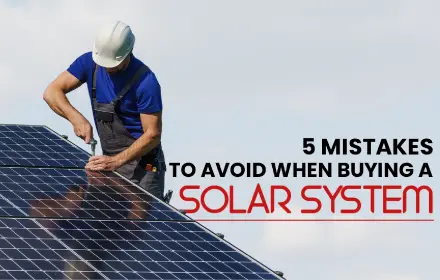
As India accelerates its transition to renewable energy, solar power systems have become a smart investment for both homeowners and businesses. However, the complexity of solar technology and the diversity of products and vendors can overwhelm first-time buyers. This often leads to costly mistakes that undermine the system’s performance, durability, and overall value.
At Orient Solar, we combine technical expertise with deep market knowledge to help you avoid these common pitfalls. Here are five critical mistakes you must avoid when purchasing a solar power system in India, ensuring your solar investment is both effective and sustainable.
The foundation of an efficient solar system is an accurate understanding of your electricity usage. Without this, it’s impossible to design a system that fits your needs.
Underestimating your load leads to insufficient power generation and continued dependence on grid electricity.
Overestimating results in overspending on unnecessary capacity.
Collect and analyze your electricity bills for the past year, noting monthly kWh consumption.
Factor in seasonal variations and future changes, such as adding new appliances or expanding your home or business.
Consult certified solar engineers or trusted companies like Orient Solar for a detailed energy audit using smart meters and load analysis.
Orient Solar’s expertise: We perform comprehensive energy audits to design systems that precisely match your usage pattern, optimizing cost-efficiency and performance.
Not every rooftop is solar-ready. Structural soundness, orientation, shading, and available space significantly impact system efficiency and safety.
Orientation & Tilt: South-facing roofs with 15° to 30° tilt capture maximum sunlight in India.
Shading: Trees, buildings, chimneys, or rooftop equipment can create shading that drastically reduces panel output.
Structural Integrity: The roof must support panel weight without compromising its durability or safety.
Shaded or improperly oriented panels can reduce energy yield by 20-40%. Ignoring roof conditions can lead to costly repairs or system failure.
Orient Solar’s solution: Our site engineers conduct detailed rooftop and environment surveys, using shading analysis tools and structural assessments to ensure optimal panel placement and long-term safety.
While upfront cost matters, selecting solar panels or components solely on price compromises efficiency, reliability, and warranty coverage.
Panel Type: Monocrystalline and TOPCon panels offer the highest efficiency (18%-22%) and temperature tolerance, suitable for Indian climates.
Certifications: Panels must have BIS, IEC 61215, IEC 61730 certifications, and MNRE approval to ensure compliance with Indian standards.
Warranty: Choose panels with at least 25 years of performance warranty and 10 years of product warranty.
Faster degradation reduces lifespan and output.
Poor build quality leads to mechanical failures.
Lack of proper warranty support.
Orient Solar’s commitment: We manufacture and supply only certified, high-efficiency solar panels, backed by robust warranties and tested for Indian weather conditions.
Your location, energy goals, and grid availability dictate whether you need an on-grid, off-grid, or hybrid solar system. Choosing incorrectly affects performance and ROI.
On-grid: Connected to the electricity grid; allows net metering to export excess energy. No battery backup, so power is lost during outages.
Off-grid: Independent of the grid; uses battery storage to provide power. Higher cost and maintenance but essential where grid reliability is poor.
Hybrid: Combines grid connectivity and battery storage, offering backup during outages and energy export.
Grid availability and reliability at your location.
Budget constraints and maintenance willingness.
You need energy independence or an uninterrupted power supply.
Orient Solar’s approach: We assess your site’s grid conditions and usage patterns to recommend the ideal system type for maximum savings and reliability.
India offers multiple subsidies and incentives for solar adoption, but navigating this landscape can be complex.
MNRE subsidies can reduce system costs by 20%-40% for residential and commercial installations.
Net metering allows you to sell excess electricity to the grid, further improving returns.
Purchasing from non-MNRE-approved vendors disqualifies you from subsidies.
Failing to complete or properly file net metering applications.
Delaying paperwork, causing installation or incentive processing delays.
Orient Solar’s support: We ensure all our installations are MNRE-approved and assist clients with end-to-end subsidy applications, net metering registration, and compliance documentation to maximize your financial benefits.
Buying a solar power system is a long-term investment that requires a clear understanding and careful planning. Avoiding these five mistakes will ensure you get a high-performing, durable, and cost-effective solar solution.
Orient Solar’s commitment to quality, expert consultation, and customer support makes us a trusted partner in India’s solar revolution. Contact us today for a detailed site evaluation and a personalized solar solution designed to maximize your savings and minimize your environmental impact.
Frequently Asked Question
Request A Quote