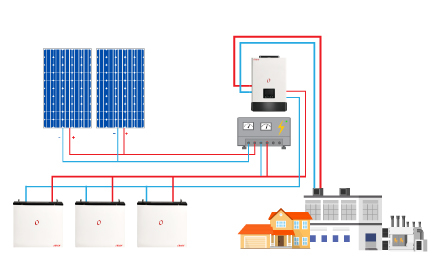
Still trying to decide between an on-grid, off-grid, or hybrid solar system? This guide explains the exact difference between on-grid, off-grid and hybrid solar systems, answers the popular query “which is better – on-grid or off-grid?”, and shows when a hybrid solar system delivers the best of both worlds for homes and industries in India.
If you live in a metro where power cuts are rare, the electricity bill is your biggest pain point; if you farm in a village, a sudden outage can ruin an entire harvest; and if you run a factory, even ten minutes of downtime can trigger hours of rework.
That is why more Indian homeowners and businesses type on grid vs off grid solar system into Google every day. Yet most people still feel overwhelmed by jargon, battery options, and subsidy rules. In this human-friendly guide, we unpack the technology, debunk common myths, and help you pick a system that fits your budget, your lifestyle, and your long-term energy goals.
An on-grid solar system (also called grid-tied) connects your rooftop panels to the local DISCOM network through a bidirectional meter. In bright sunlight your appliances draw solar energy first; any extra units flow into the grid and earn credits through net-metering.
Why people choose on-grid:
Lowest upfront cost – no battery bank means fewer components to buy.
Fastest payback – exported units directly offset your monthly bill.
Simple maintenance – panels, inverter, and meter are the only moving parts.
Best suited for city flats, offices, retail outlets, and factories in industrial zones where power cuts are occasional and brief. If your search is “which is better on-grid or off-grid for a well-connected urban home,” on-grid usually wins on price and ROI.
An off-grid solar power system operates as a self-contained micro-grid. Panels charge a battery during daylight; at night or in cloudy weather, an inverter draws that stored energy and converts it to AC for your loads.
Why people choose off-grid:
Complete independence – ideal for farms, hill resorts, telecom towers, or remote warehouses where the nearest pole transformer is kilometres away.
Energy security – no more diesel bills or anxious waits for supply lines to be fixed.
Future resilience – once built, your site can function through storms, floods, or policy changes.
Things to plan for: battery size, depth-of-discharge, and realistic load forecasting. Searchers who type “affordable off-grid solar power system with battery in India” should note that lithium prices have fallen sharply, making autonomy more accessible than ever—provided you size the bank correctly and monitor it with a smart charge controller.
A hybrid solar system blends the two worlds: you stay connected to the grid and install a battery bank, typically managed by a smart on-grid/hybrid inverter. When the sun shines, the system powers your loads first, charges the battery second, and exports any extra units third. During a blackout, it automatically islands itself and runs critical appliances without interruption.
Why hybrid popularity is soaring:
Rising urban outages – heatwaves and over-stretched grids now trigger load-shedding even in Tier-1 cities.
24/7 lifestyles – refrigerators, Wi-Fi routers, medical devices, and data servers cannot afford a five-minute gap.
Time-of-day tariffs – some states already reward you for consuming stored solar at night instead of drawing peak-rate power.
Hybrid systems make the most sense for households and industries that experience frequent black-outs yet still want the financial upside of net-metering when the grid is healthy.
Battery Presence
On-grid: none.
Off-grid: always.
Hybrid: optional but central.
Upfront Investment
On-grid is the lightest on your wallet.
Off-grid is highest because storage costs more than panels.
Hybrid sits in the middle.
Performance During Blackouts
On-grid shuts down for safety.
Off-grid stays alive as long as batteries last.
Hybrid rides through seamlessly by drawing on stored energy.
Typical Payback
On-grid often recovers cost within 3–4 years in India.
Off-grid takes longer but removes your energy bill forever.
Hybrid balances both, especially valuable where outages occur three or more times a week.
Scenario 1: Reliable grid, high daytime usage
If you live in a well-supplied suburb and run ACs, washing machines, or EV chargers mostly while the sun is up, an on-grid installation will offset a large chunk of your bill at the lowest capital cost.
Scenario 2: Frequent power cuts, critical appliances
Do your kids study online at night? Do you keep medication in a fridge that must never fail? A hybrid solar system ensures uninterrupted power while still exporting excess energy on good days.
Scenario 3: No grid access at all
Perhaps your homestay sits on a hillside where poles cannot reach. An off-grid solution is the only route to round-the-clock electricity, and modern lithium batteries make it lighter and longer-lasting than the lead-acid banks of old.
Urban factories and warehouses benefit most from on-grid: daytime machinery aligns perfectly with sunlight hours, and a single net-metered feeder can shave lakhs off annual OPEX.
Healthcare, IT, data-centres, and cold-storage facilities lose crores in minutes of downtime; hence they lean towards hybrid, where battery backup kicks in instantly and diesel gensets shrink to a secondary role.
Remote agro-processing units, mines, and telecommunication relays survive on off-grid arrays, using intelligent charge algorithms to stretch battery life and keep diesel drums sealed except for emergencies.
Rooftop Audit – ensure at least five sunlit hours without shade; use smartphone-based PV mapping if professional software is unavailable
Load Profile – list appliances with wattage and daily run-time; oversizing by 10 % covers seasonal spikes.
Inverter Selection – decide between standard string inverters for on-grid, stand-alone inverters for off-grid, or on-grid vs hybrid inverter models that support battery expansion later.
Subsidy Path – under the PM Surya Ghar Yojana, residential customers can claim up to ₹78 000 for the first 3 kW; hybrid batteries are currently not subsidised but can be added without affecting rooftop incentives.
Net-Metering Paperwork – file the online application, get a site inspection, and install a bidirectional meter; most DISCOMs approve within 15–30 days.
Maintenance Plan – quarterly cleaning, annual tightening of DC connectors, and software updates for hybrid controllers keep generation high.
“Off-grid always costs double.” Battery prices fell over 15 % in 2024; with smart load shifting, total system cost can be manageable.
“On-grid is useless during a blackout.” True today, but hybrid-ready inverters allow you to add storage later, protecting your initial investment.
“Hybrid is just on-grid plus UPS.” Modern hybrids prioritise solar-to-load, solar-to-battery, battery-to-grid, and even EV charging in real time, squeezing every rupee of savings.
Choosing between on-grid, off-grid, and hybrid solar systems boils down to three questions:
How reliable is your current grid supply?
How much downtime can you tolerate?
How quickly do you need payback?
For most city homes and factories, on-grid delivers the swiftest savings; for remote or outage-plagued sites, off-grid guarantees autonomy; and for anyone who can’t afford a single minute of darkness, hybrid offers security without sacrificing net-meter credits.
Ready to act? Orient Solar designs, manufactures, and installs tailor-made on-grid, off-grid, and hybrid solutions across India. Request a free site survey today and turn your roof into a power plant that never sleeps.
Frequently Asked Question
Request A Quote