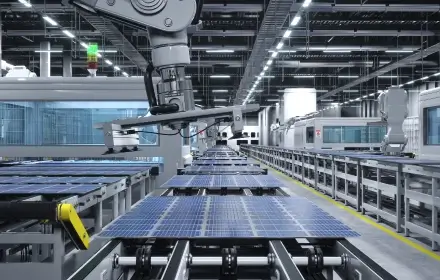
Solar energy is transforming the way we power our world. At the heart of this clean energy revolution is the solar panel manufacturing process. From crafting solar cells to assembling the final solar modules, every step demands precision, advanced technology, and innovation. In this blog, we’ll guide you through the solar module manufacturing process, explain how solar cells are made, and share insights into solar panel manufacturing equipment and Orient Solar’s state-of-the-art solar panel manufacturing plant — all based on the expertise of Orient Solar, one of the top solar PV manufacturers in India.
Solar panels consist mainly of photovoltaic (PV) cells, usually made from high-purity silicon. These cells convert sunlight into electricity using the photovoltaic effect. Multiple interconnected solar cells form a solar module, and combining modules creates a complete solar panel system. Essential components also include tempered glass, aluminum frames, encapsulants like EVA (ethylene vinyl acetate), and a durable backsheet.
The manufacturing process begins with sourcing ultra-pure silicon, often extracted from quartz sand. This material undergoes chemical treatments to remove impurities, laying the foundation for efficient photovoltaic cell manufacturing. Other materials include EVA sheets, tempered glass, backsheet layers, conductive pastes, and aluminum frames — all vital for assembling high-quality solar modules.
Doping: Phosphorus or boron is added to create the P-N junction.
Texturization: The wafer surface is roughened to reduce reflection and improve sunlight absorption.
Anti-Reflective Coating: A special layer is applied to trap more sunlight.
Metal Contacts: Conductive metal contacts are printed on the wafer to collect and transport electricity.
The cells are connected in series and parallel, sandwiched between EVA sheets, tempered glass, and a backsheet. The assembly is laminated under heat and pressure, then framed with aluminum and fitted with junction boxes.
Orient Solar strictly tests every solar panel. Electroluminescence (EL) testing detects microcracks, flash testing measures power output, and mechanical load testing verifies resistance to environmental stresses. These tests ensure the panels meet global quality standards and offer long-lasting performance.
High-tech machinery is key to efficient manufacturing. This includes ingot growing furnaces, wire saws for wafer slicing, diffusion furnaces for doping, screen printers for metal contacts, laminators, and framing machines. Automation reduces errors and maintains consistent quality across the solar panel manufacturing process.
Orient Solar’s manufacturing plant uses advanced technology and follows global best practices. With an annual capacity, the facility produces monocrystalline, polycrystalline, bifacial, and TOPCon solar panels for both domestic and international customers. This solar panel manufacturing plant stands as one of the most efficient in India, employing cutting-edge automation and eco-friendly processes.
The solar panel manufacturing industry has embraced sustainability. Facilities implement water recycling, emission control, and silicon reuse to reduce environmental impact. According to the International Renewable Energy Agency (IRENA), solar PV technology has the potential to cut global CO2 emissions by 4.9 gigatonnes annually by 2050.
The future holds smarter manufacturing with AI-driven quality control, fully automated assembly lines, and the development of next-generation recyclable solar panels like perovskite cells. Orient Solar invests in these innovations to lead the renewable energy sector and maintain its position among the leading solar PV manufacturers.
As one of India’s leading solar manufacturers, Orient Solar offers high-efficiency solar modules with robust quality control and certifications. We provide customized solutions for residential, commercial, and utility-scale solar projects, committed to delivering clean, affordable, and reliable solar energy.
Frequently Asked Question
Request A Quote