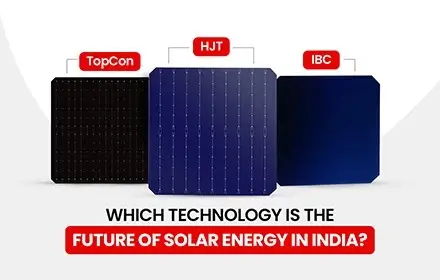
With the world rapidly moving toward a clean energy future, the solar sector is experiencing significant innovation. Some of the most exciting innovations include TOPCon, HJT, and IBC; three new solar technologies transforming the solar energy system. Which is better, TOPCon, HJT, or IBC? And more importantly, what does this mean for the future of solar technology in India?
This blog by Orient Solar helps to compare TOPCon, HJT, and IBC solar modules, their advantages, and their opportunities to lead the solar panel future in India.
We will review and evaluate how each of these next-gen solar cell technologies differ across structure, efficiency, and manufacturability.
TOPCon solar PV modules, which contain tunnel oxide coupled with a passivated contact, are a new technology that reduces electron recombination, thereby improving cell efficiency. Even though this technology is a newer generation of PERC technology (passivated emitter rear cells,) with slightly greater conversion efficiencies and better low-light performance.
Advantages of TOPCon over HJT and IBC:
HJT solar PV modules consist of a crystalline silicon base, with amorphous silicon layers (HJT). Overall, HJT makes for high-efficiency applications and great thermal stability; however, it is a more expensive and complicated production method.
Key strengths:
On the other hand, HJT also faces challenges in terms of manufacturing costs and reduced compatibility with existing plants, which limits its scalability in markets like India.
IBC solar PV modules conceal all of the contacts at the back of the cell to allow maximum exposure of the front surface to sunlight. There are some of the most efficient solar panels out there.
Highlights:
The downside to IBC modules is that they are expensive to manufacture and increasingly difficult to scale, in price-sensitive markets like India.
|
Feature |
TOPCon |
HJT |
IBC |
|
Efficiency |
22–23% |
22–24% |
23–25% |
|
Temperature Coefficient |
-0.3%/°C |
-0.25%/°C |
-0.29%/°C |
|
Bifaciality |
High (80-85%) |
Very High (90%) |
Low |
|
Manufacturing Cost |
Medium |
High |
Very High |
|
Compatibility with PERC lines |
Yes |
No |
No |
|
Market Scalability (India) |
High |
Moderate |
Low |
The comparison of the different solar cell technologies outlined above clearly illustrates where the best combination of cost, efficiency and scalability lies, particularly for India’s solar module manufacturing ecosystem.
The question on many minds is: what is the future of solar panel technology?
Although IBC is the technical leader when it comes to absolute performance, given its cost per watt, IBC is simply not viable for mass deployment in developing markets. HJT is set to play an important role in niche and premium projects; however, TOPCon is becoming the most commercially relevant technology for the next 5–10 years.
Orient Solar is committed to leading the next wave of advanced PV cell technology with TOPCon solar PV modules that meet global quality standards while also tailoring them to the needs of the Indian market.
India is positioned to be a solar manufacturing powerhouse, with solid government support, especially through schemes like the PLI (Production Linked Incentive). Many players, through the utility, commercial, and residential space, have shown great demand for high-efficiency solar panels.
Technologies like TOPCon fit perfectly into this future:
Orient Solar believes that TOPCon is the best solar technology of the future for India - providing the best balance between efficiency, price, and longevity.
When considering TOPCon vs HJT vs IBC, there isn't a clear answer. However, if we look at current trends in solar panel technology - as well as the needs of the market and the economic landscape, then TOPCon is on top as the best solar technology for the Indian market.
At Orient Solar, we aren't simply observing the future of solar technology, we are creating it. Our advanced manufacturing, commitment to innovation and focus on quality make us a trusted solar partner for India's energy future.
Frequently Asked Question
Request A Quote